
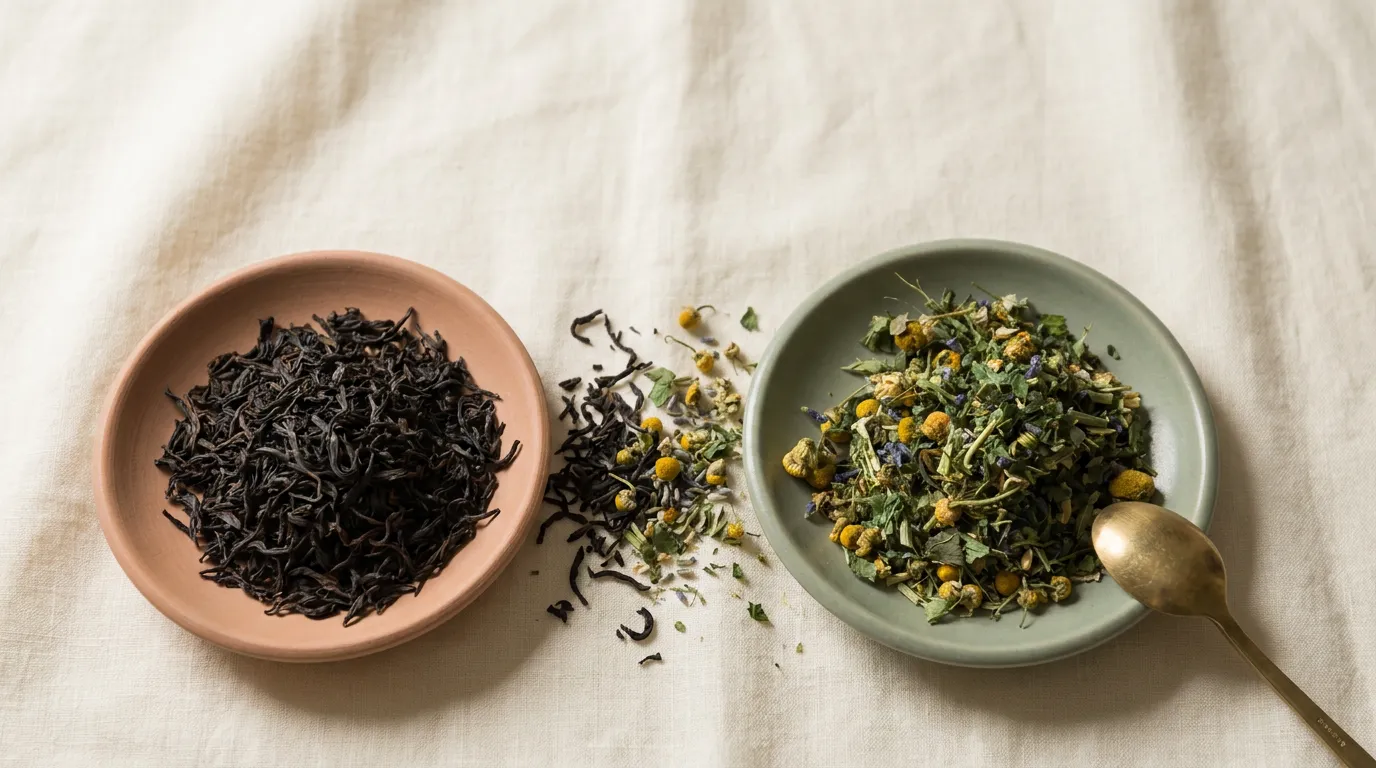
True Tea Vs Herbal Tea – What is the difference
Key Takeaways:
True tea comes from the leaves of one plant, Camellia sinensis.
Herbal tea, properly called a tisane, is made from any other plant: flowers, leaves, roots, seeds, bark or fruit.
Between the two sit blends like Australian Breakfast, chai and French Earl Grey, which are true tea with botanicals added, so they carry caffeine even though they taste of far more than tea.
Herbal tea and tisane mean the same thing, and neither contains tea leaves at all.
Table of contents (click to jump)
- What is the difference between true tea and herbal tea?
- What counts as true tea?
- Where do blends like Earl Grey and chai fit?
- What is a tisane and how does it compare to herbal tea?
- Frequently asked questions
The word tea does two jobs. One is botanical and narrow, meaning leaves from a single species. The other is what most of us mean standing at the kettle, which is anything worth pouring hot water over. Chamomile, peppermint and rooibos belong firmly to the second, and knowing which is which tells you, at a glance, whether the cup in front of you will keep you awake.
What is the difference between true tea and herbal tea?
True tea is made from the leaves and buds of Camellia sinensis, and nothing else qualifies. Herbal tea is an infusion of any other plant, which is why tisane is the more precise word for it. The practical difference is caffeine: true tea always has it, a herbal infusion never does.
True tea | Blended or flavoured tea | Herbal tea, or tisane | |
Made from | Camellia sinensis only | True tea plus botanicals | Botanicals only, no tea leaf |
Caffeine | Yes | Yes | None |
Typical steep | 2 to 5 minutes | 3 to 5 minutes | 5 to 10 minutes, often longer |
If you forget it | Turns astringent | Turns astringent | Usually just deepens |
On our shelf | A single origin black or green | Australian Breakfast, chai, French Earl Grey | Chamomile, rooibos, fruit and berry |
Correct name | Tea | Tea | Tisane |
Caffeine is the difference you feel. Every true tea contains it, and the amount has less to do with the type than most packaging suggests. A 2008 analysis of 20 commercial teas found 14 to 61 mg per serving across white, green and black, with no observable trend by variety, and no caffeine detected at all in the herbal ones (1). True teas also carry L-theanine, an amino acid found in the tea plant that arrives alongside the caffeine, measured across all six tea types in a 2025 study (2). A tisane brings neither, which is exactly why a caffeine-free blend works at nine in the evening when a black tea would not.
They behave differently in hot water. Tea leaves are rich in catechins, and as the leaf is processed those catechins are enzymatically converted into the theaflavins and thearubigins that give darker teas their colour (3). The same compounds are what dries your mouth if you overshoot the timer. A 2022 in vitro study found that extending brewing time raised astringency exponentially rather than in a straight line (4), which is why an extra minute on a green tea is punished so sharply. Flowers, roots and fruit hold nothing that behaves that way, so a chamomile forgives you completely. Leave it 15 minutes and it only gets rounder and sweeter.
Tisanes ask for more of the plant and more time. The European Medicines Agency monograph for chamomile flower specifies 1.5 to 4 g in 150 ml of boiling water, taken 3 to 4 times daily, which is a far heavier hand than you would use with a tea leaf (5). Roots and barks want longer again than flowers and leaves. If you want the numbers for each, they sit in our guide to getting the ratio and steep right.
What counts as true tea?
Six types, all of them from Camellia sinensis, separated by how far the leaf was allowed to oxidise before heat stopped the process. The six types of tea run from pale and honeyed to dark and earthy, and those differences matter far more to your cup than the plant they have in common.
Where do blends like Earl Grey and chai fit?
They sit between the two, and they are still tea. A blend takes a true tea as its base and adds botanicals to it, so the caffeine comes with it even though the flavour is mostly coming from somewhere else. This is where a large part of what people drink daily actually lives.
Our French Earl Grey is a black tea scented with bergamot and softened with lavender and rose. Chai is black tea with cardamom, cinnamon, ginger and pepper. Jasmine Green is a green tea scented with jasmine blossom. In each case the botanicals shape the taste and the tea leaf carries the body, the tannin and the caffeine.
The distinction matters most when you are reading a label at the end of the day. A packet can be full of flowers and spice and still be a black tea underneath, so the test is not what you can smell but whether tea appears in the ingredients. If it does, it will keep you awake. If it does not, you are holding a tisane, however tea-like it looks.

An award-winning organic black tea infused with refreshing citrus tones and fragrant French florals.
Select Options This product has multiple variants. The options may be chosen on the product page
A premium grade green tea infused with fragrant jasmine and delicate rose. Naturally restores energy levels.
Select Options This product has multiple variants. The options may be chosen on the product page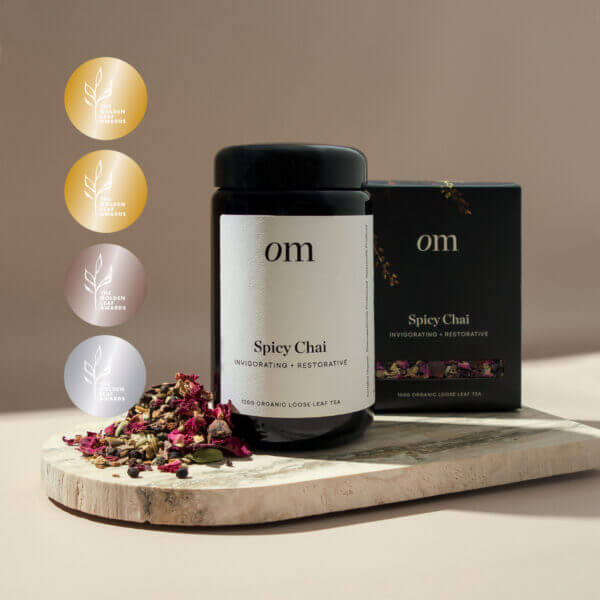
This spiced chai is an award-winning, caffeine free blend of traditional Indian spices with citrus-rose overtones.
Select Options This product has multiple variants. The options may be chosen on the product page
A black tea boasting aromatic native lemon myrtle notes with warm woody eucalypt tones, made in Sydney.
Select Options This product has multiple variants. The options may be chosen on the product pageWhat is a tisane and how does it compare to herbal tea?
They are the same thing. Tisane is simply the more precise word, used in herbal medicine and across most of Europe, for an infusion made from any plant that is not the tea plant. Herbal tea is what almost everyone says instead, and there is nothing wrong with it.
The word is French, from an older Greek term for a barley drink, and it has described herbal preparations for centuries. What makes tisanes a category in their own right rather than a variation on tea is that they are not limited to leaves. Any part of a plant can carry the flavour, and each part brings something a tea leaf cannot.
Flowers. Chamomile, lavender, rose and hibiscus. Delicate, aromatic and light enough that you need roughly twice the volume you would use of a rolled tea leaf. Chamomile is the one most people meet first, in blends like our Restful Tea.
Leaves. Peppermint, lemon verbena, lemon balm and rooibos, the last from a South African shrub that brews red and naturally sweet, as in Rooibos Tea with Rose. Leaves give up their flavour readily, which is why a peppermint fills the kitchen before you have finished pouring.
Roots and barks. Ginger, liquorice, dandelion root and cinnamon. Dense, slow to release and warming, they reward a longer steep than anything else on this list. Liquorice root in particular brings its own sweetness with no sugar involved, like in our Energy Tea.
Seeds and fruit. Fennel, cardamom, rosehip, dried berries and citrus peel. Fennel is soft and aniseed-like, while berry and hibiscus blends brew a deep crimson and taste properly tart.
That range is the point. A true tea can only ever taste like a tea leaf handled six different ways, remarkable as those differences are. A tisane can taste like a garden, a spice drawer or a fruit bowl, and it can do it at any hour you like. If you want to know what any single herb actually is and how it has traditionally been used, our Materia Medica works through them one at a time.
Frequently asked questions
Not botanically. Real tea, or true tea, means Camellia sinensis, and herbal tea is an infusion of other plants entirely. The name stuck because both are dried plant material and hot water in a cup, and there is no reason to stop saying herbal tea. It just helps to know that a chamomile and a Darjeeling have nothing in common beyond the method.
No. Earl Grey is a black tea scented with bergamot, so it is a flavoured tea rather than a herbal one, and it contains caffeine. The same goes for chai, jasmine green and most breakfast blends. Botanicals in the ingredient list do not make something herbal. The absence of tea leaves does.
Almost all of it, with two things to watch. Yerba mate and guayusa are plant infusions that do contain caffeine, and they are often shelved alongside herbal blends. And anything listing green, black or white tea in its ingredients is not caffeine free, however herbal the front of the packet looks. Reading the ingredient list settles it in a second.
No. Rooibos comes from Aspalathus linearis, a shrub from the Cederberg region of South Africa, and has no relationship to the tea plant. It is naturally caffeine free, brews a deep red, and tastes sweet and slightly woody with no sugar added. Green rooibos is the same plant left unoxidised, and it comes out lighter and grassier.
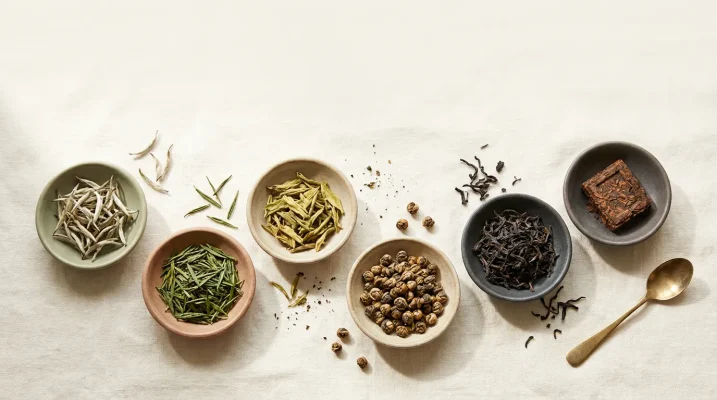
A simple guide to the different types of tea
Learn about the six true type of teas, what each tastes like, how oxidation makes [...]
Sep
How to make loose leaf tea
How do you make loose leaf tea at home? Ratios, temperatures and steeping times by [...]
Aug

How to store loose leaf tea: The complete guide to keeping it fresh
Learn how to store loose leaf tea the right way: What containers are best, where [...]
Aug
References
Chin JM, Merves ML, Goldberger BA, Sampson-Cone A, Cone EJ. Caffeine content of brewed teas. Journal of Analytical Toxicology, 2008. https://pubmed.ncbi.nlm.nih.gov/19007524/
Ayakdaş G, Ağagündüz D. Determination of L-Theanine and Caffeine Contents in Tea Infusions with Different Fermentation Degrees and Brewing Conditions Using the Chromatographic Method. Foods, 2025. https://pubmed.ncbi.nlm.nih.gov/40647065/
Abudureheman B, Yu X, Fang D, Zhang H. Enzymatic Oxidation of Tea Catechins and Its Mechanism. Molecules, 2022. https://www.ncbi.nlm.nih.gov/pmc/articles/PMC8840101/
Liu CT, Tzen JTC. Exploring the Relative Astringency of Tea Catechins and Distinct Astringent Sensation of Catechins and Flavonol Glycosides via an In Vitro Assay Composed of Artificial Oil Bodies. Molecules, 2022. https://www.ncbi.nlm.nih.gov/pmc/articles/PMC9457659/
European Medicines Agency, Committee on Herbal Medicinal Products. European Union herbal monograph on Matricaria recutita L., flos, 2015. https://www.ema.europa.eu/en/documents/herbal-monograph/final-european-union-herbal-monograph-matricaria-recutita-l-flos-first-version_en.pdf