
Our adaptogen range brings ashwagandha, reishi and other adaptogenic herbs into certified organic tea and raw cacao, for the weeks when the demands outlast the reserves.

OM's Energy Tea offers uplifting citrus, restorative earthy elements and hints of liquorice. Award-winning.
Select Options This product has multiple variants. The options may be chosen on the product page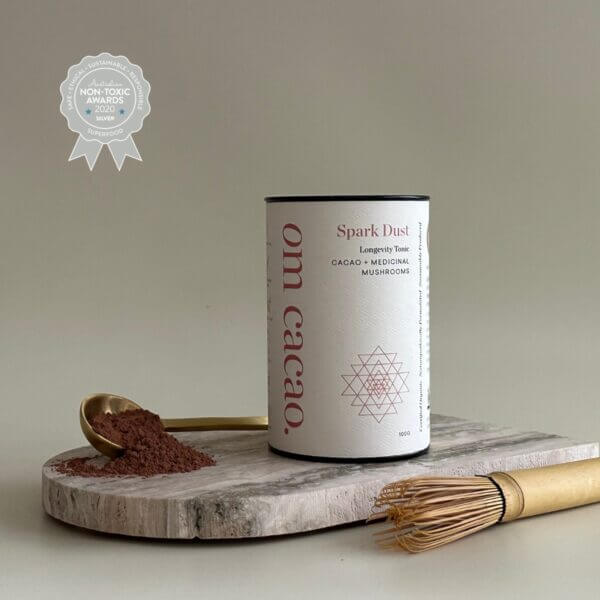
Raw cacao with reishi and shiitake mushrooms, formulated with vitality and longevity in mind.
Select Options This product has multiple variants. The options may be chosen on the product page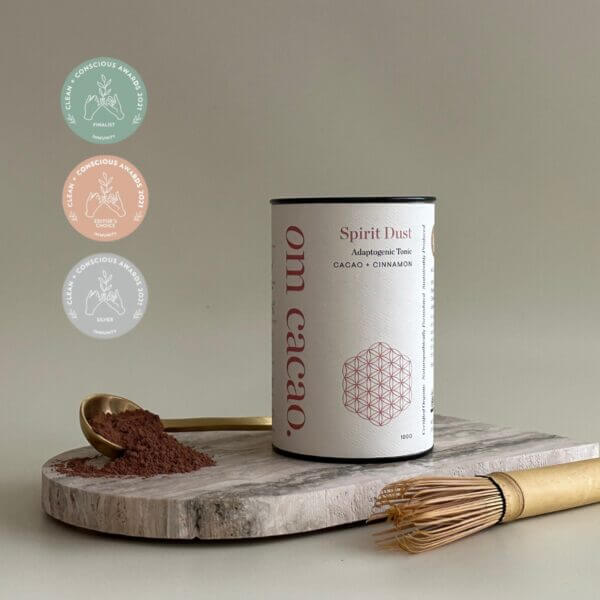
Raw cacao with ashwagandha, Siberian ginseng and cinnamon, formulated with calm and resilience in mind.
Select Options This product has multiple variants. The options may be chosen on the product page
What adaptogens are
An adaptogen is a herb that helps the body cope with stress in a non-specific way, rather than acting on one system in one direction. The term was coined by Soviet pharmacologists in the mid-twentieth century, and the original definition set three conditions: the herb must be broadly non-toxic, it must produce a non-specific response that raises resistance to physical, chemical and biological stressors, and it must have a normalising influence regardless of the direction of the problem. That last condition is what separates an adaptogen from a stimulant, which only pushes one way.
In practice, the herbs that meet those criteria are mostly roots, barks and fungi with long histories in Ayurvedic and Chinese traditions, and they behave differently from the herbs most people are used to. Adaptogens are not something you take when you feel bad and stop when you feel better. They are traditionally taken steadily, over a stretch of weeks, which is why they suit a daily drink better than most delivery formats.
FAQ and further info about adaptogens
The list that meets the classical criteria is shorter than the marketing suggests. Ashwagandha, rhodiola, holy basil, Siberian ginseng, schisandra, astragalus and liquorice are the herbs most consistently classified as adaptogenic, alongside several fungi including reishi and cordyceps. Plenty of other ingredients are sold under the label without meeting the definition, so it is worth reading the ingredient list rather than the front of the packet.
The proposed mechanism is that they act on the hypothalamic-pituitary-adrenal axis, the system that governs the body's stress response, moderating it rather than blocking or driving it. That is the theory, and the research is genuinely mixed: some adaptogens have a reasonable body of clinical evidence behind them and others have very little beyond traditional use. Anyone claiming certainty about how they work in the body is overstating what is known.
Longer than most people expect. The traditional and clinical use of adaptogens is cumulative, measured in weeks rather than cups, and the effect described is usually a change in baseline rather than a noticeable lift on any given day. If you are looking for something immediate, an adaptogen is the wrong tool, and a cup from our energy and vitality collection is a better starting point.
For most people, in food quantities, yes, and daily use is how they are traditionally taken. The caveats matter though. Individual adaptogens have their own contraindications, some interact with medications, and a few are not appropriate during pregnancy or with thyroid or autoimmune conditions. Full ingredient lists are on every product page, and if you are pregnant, breastfeeding or taking any medication, talk to your healthcare professional before making an adaptogenic blend a daily habit.
Choose by what you want it alongside. Our Energy Tea is the option for anyone who wants adaptogenic herbs in a caffeine-free tisane. If you would rather drink cacao than tea, Spirit Dust pairs raw cacao with ashwagandha, cinnamon and ginger, and Spark Dust is built on reishi. All three are certified organic and naturopathically formulated.
No, though the categories overlap and the words are often used loosely. Adaptogens are defined by their effect on the stress response. Nootropics are defined by their effect on cognition, whether that is focus, memory or mental clarity. Some herbs are credibly described as both, but the terms answer different questions, and a product marketed as a nootropic is not necessarily adaptogenic.