
How to store loose leaf tea: The complete guide to keeping it fresh
Key Takeaways
Tea storage needs five things: an airtight seal, opacity, a cool spot, a dry spot and distance from anything with a smell.
Most tea does not spoil. It fades. The leaf is still safe long after it has stopped being worth drinking.
Green, white and matcha fade fastest. Black, oolong and pu-erh are far more forgiving.
The clear glass jar on the benchtop is the single most common mistake, and it undoes almost everything else you do well.
The fridge is rarely the answer, and for most teas it causes the exact problem it is meant to solve.
Faded tea is not rubbish. Cold brew, cooking and the bath will all take it happily.
You know the moment. You open a new pouch of loose leaf tea and the whole kitchen shifts. There is that first lift of aroma, green and sweet and alive, and you think this is going to be good.
Six months later you are drinking the same tea and it is fine. Just fine. Flat, a little dusty, nothing like the cup you remember. Nothing has gone wrong in any dramatic sense. The leaf has not spoiled and it will not make you unwell. It has simply been quietly leaking its aroma into your kitchen cupboard for half a year, and the cup you are holding is what is left.
We are meticulous about water temperature and steeping time and the shape of the pot, and then we tip a beautiful single-origin green into a clear jar next to the kettle and wonder why it tastes tired by autumn. Learning how to store loose leaf tea properly is the least glamorous thing you can do for your tea, and it is easily the highest-impact.
Here is the whole thing, starting with the short version.
How should you store loose leaf tea?
Store loose leaf tea in an airtight, opaque container that is close to the size of the amount of tea you have, kept in a closed cupboard away from the stove, kettle, dishwasher and any window. Use a dry spoon every time, keep the scoop outside the jar and keep strongly scented blends on a separate shelf.
That is the entire method. If you do nothing else in this article, do those things and you will already be ahead of most people who care about tea.
Three details make the difference between doing it and doing it well:
Match the jar to the quantity. A large jar holding a small amount of tea is mostly air, and air is what fades tea. Decant into something smaller as you work through it.
Buy less, more often. A 50 g pack you finish in six weeks will always taste better than a 250 g pack you finish in eight months, whatever jar you put it in.
Treat green, white and matcha differently. These are the fragile ones. Everything else is fairly hard to ruin.
The rest of this guide explains why each of those works, what changes for different teas, and what to do about an Australian summer.

A black tea boasting aromatic native lemon myrtle notes with warm woody eucalypt tones, made in Sydney.
Select Options This product has multiple variants. The options may be chosen on the product page
A berry and honeybush tea with hibiscus and rose overtones. Brilliant crimson colour. Award-winning.
Select Options This product has multiple variants. The options may be chosen on the product page
A premium grade green tea infused with fragrant jasmine and delicate rose. Naturally restores energy levels.
Select Options This product has multiple variants. The options may be chosen on the product page
An award-winning, restorative herbal tea offering a harmonious medley of precious petals with refreshing florals.
Select Options This product has multiple variants. The options may be chosen on the product pageWhat actually ruins loose leaf tea?
Loose leaf tea is ruined by five specific things: air, light, heat, moisture and odours. None of them make tea unsafe in the way we usually think about food going off. They strip away the volatile aromatic compounds and pigments that made the tea worth buying, and they do it slowly enough that you rarely notice until the damage is done.
That distinction matters, because it changes how you think about storage. You are not preventing spoilage. You are slowing down a fade that has already begun.
How does air oxidise tea?
Oxygen reacts with the compounds in dried tea leaf, breaking down the aromatics that give tea its character and generating new compounds that taste stale instead. Research on Longjing green tea found that the stale odour developing in stored tea is driven largely by ketones and alcohols produced through carotenoid degradation and lipid oxidation, which is why old green tea drifts towards woody and fatty notes rather than simply tasting weaker (1).
The same study found that packaging designed to remove oxygen preserved aroma quality noticeably better over eighteen months than packaging without it, at both refrigerated and room temperature (1). You are not going to nitrogen-flush anything at home. You can control how much oxygen sits in the jar, which is the same idea at a domestic scale.
That is where headspace comes in. A 500 ml jar holding 30 g of tea is mostly air, and every time you open it you swap that air for a fresh supply of oxygen. It is the reason a half-empty jar goes downhill so much faster than a full one.
Why does light damage tea?
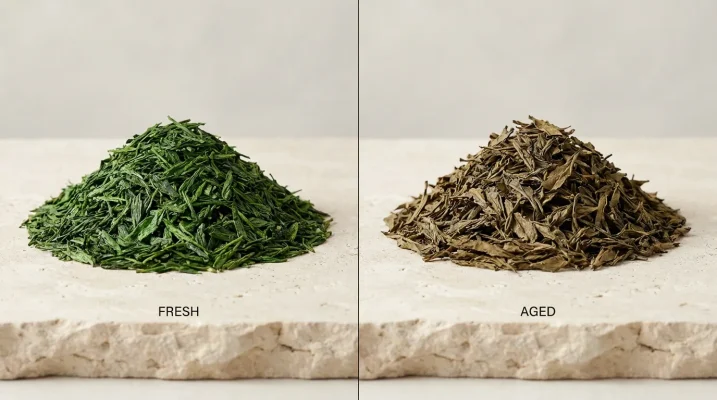
Light, particularly UV, breaks down chlorophyll and the volatile oils that carry aroma. It is why tea stored in clear glass on a sunny bench loses its colour first and its flavour shortly after, shifting from bright green towards a dull olive brown.
Green and white teas suffer most because they retain the most chlorophyll and the most delicate aromatics. Black tea has already been through full oxidation during processing, so it has less left to lose. But no tea benefits from light, and in an Australian home this matters more than in most. Even indirect summer daylight through a kitchen window is doing steady work over months.
What does heat do to tea?
Heat accelerates every other form of degradation happening in the jar. It speeds up oxidation, drives off volatile aromatics and pushes the chemical reactions that break down the leaf’s beneficial compounds.
It is also the factor most people underestimate. In a study of catechin stability in green tea powder stored across a range of humidity and temperature conditions, temperature was the dominant factor in degradation, ahead of relative humidity (2). Given that a closed kitchen in a Sydney or Perth February can sit above thirty degrees for days at a time, the room your tea lives in deserves as much thought as the jar you put it in.
Why is moisture the most dangerous of all?
Moisture is the only one of the five that can make tea genuinely unsafe rather than just disappointing. Dried tea leaf is hygroscopic, meaning it pulls water out of the air, and once the moisture content rises far enough you move from a quality problem to a mould problem.
The thresholds are worth knowing. Mould growth and mycotoxin production accelerate sharply at high water activity, with the optimal range for mycotoxin production sitting between roughly 0.83 and above 0.9, alongside relative humidity of 70 to 90 per cent (3). Properly dried tea sits nowhere near that. The danger is not the leaf as it arrives, it is what happens after you introduce water.
Which is where the wet spoon comes in. A teaspoon that has been rinsed and not fully dried, dipped into a jar of tea, deposits enough moisture to create a damp pocket in an otherwise dry jar. Clumping is the first sign. Mould is the second.
Why does tea absorb odours?
Tea leaves are porous and dry, which makes them extremely effective at pulling aromatic compounds out of the air around them. This is the same property that makes jasmine scenting possible, layering fresh blossoms with green tea so the leaf takes on the perfume. It works just as well with turmeric, coffee, garlic and the inside of a cupboard.
If your tea tastes vaguely of the cupboard it lives in, this is why.
Factor | What it does to the leaf | The practical fix |
Air | Oxidises aromatics, creates stale woody and fatty notes | Airtight seal, minimal headspace, decant as the tea runs low |
Light | Breaks down chlorophyll and volatile oils, dulls colour and aroma | Opaque or violet glass container, stored inside a closed cupboard |
Heat | Accelerates every other degradation pathway | Away from the oven, kettle, dishwasher and sunny windows |
Moisture | Causes clumping, then mould and potential mycotoxins | Dry spoon every time, tight seal, no jar in the fridge |
Odours | Leaf adsorbs surrounding aromas and holds them | Airtight seal, separate shelf from spices, coffee and cleaning products |
What kind of container should you keep tea in?
The right tea container is airtight, opaque, made from an inert non-porous material and sized close to the amount of tea it holds. Every material choice below is really just a different way of meeting those four requirements, so it helps to know what you are testing for before you compare tins against glass.
What do all good tea containers have in common?
Every genuinely good tea container passes the same four tests, regardless of what it is made from. You can run all four in a shop or on your own kitchen shelf in under a minute.
The seal test. Close the container, then hold it near your face and breathe in around the join. If you can smell the tea inside, air is moving and so is aroma. A snug lid is not a seal. What you want is a silicone gasket, a clamp closure or a well-machined double lid.
The light test. Hold it up to a window with the lid on. If you can see the shape of your hand through the wall of the container, light is reaching the leaf. Full opacity passes. Violet glass passes because it filters the damaging wavelengths rather than simply being dark. Clear glass fails.
The material test. Fill it with hot water, empty it, dry it and smell the inside. If it smells of anything at all, the material is either porous or off-gassing, and it will both give flavour to your tea and take flavour from it.
The size test. Pour your tea in. If it fills less than about two thirds of the container, the jar is too big for the job.
Which material should you choose to store loose leaf tea?
There is no single best material, but each one trades off differently against those four tests. Tin and stainless steel win on light. Glass wins on neutrality. Ceramic is the one most likely to disappoint you, because the seal is usually its weak point rather than the material itself.
Material | Seal | Light protection | Odour neutrality | Practical drawbacks |
Tin, double-lidded | Good to excellent | Complete | Good, though scented blends leave traces | Dents easily, cheap tins often seal poorly |
Clear glass | Excellent with a gasket | None | Excellent | Only viable inside a dark cupboard |
Violet glass | Excellent with a gasket | Filters UV and visible light | Excellent | Costs more, you cannot see the level at a glance |
Glazed ceramic | Variable, usually the weak point | Complete | Good if fully glazed | Cork and timber lids are rarely airtight, chips let moisture in |
Stainless steel | Good to excellent | Complete | Excellent | Can feel utilitarian, check the gasket quality |
Thin plastic | Poor to moderate | Poor | Poor, holds flavours permanently | Not suitable for anything you care about |
If you want one answer: a double-lidded tin for everyday teas, and violet glass for anything you spent real money on. Our own certified organic loose leaf tea is packed in violet miron glass jars for exactly this reason, and the jars are designed to be refilled and reused.
How big should the jar actually be?
Size your jar to the volume your tea occupies, not to its weight, because 100 g of chamomile takes up roughly five times the space of 100 g of rolled oolong. This is the single most common sizing error, and it is why people end up with beautiful jars that are two thirds air.
Tea density varies enormously by leaf style. As a rough guide for 100 g:
Leaf style | Examples | Approximate volume needed for 100 g |
Tightly rolled or powdered | Gunpowder green, rolled oolong, matcha | 200 to 300 ml |
Standard twisted leaf | Most black teas, sencha, Assam, Ceylon | 350 to 450 ml |
Large open leaf | White peony, big-leaf oolong, some pu-erh | 600 to 800 ml |
Flowers, herbs and blends | Chamomile, rose, lemongrass, peppermint, chai | 1 to 1.5 litres |
Two practical consequences. First, buy the jar after you know what is going in it, not before. Second, run a two-jar system for teas you drink slowly: a large one that stays sealed and untouched, and a small working jar you actually dip into. You only expose the bulk of the tea to air when you refill.
Why is clear glass on the benchtop the most common mistake for storing loose leaf tea?
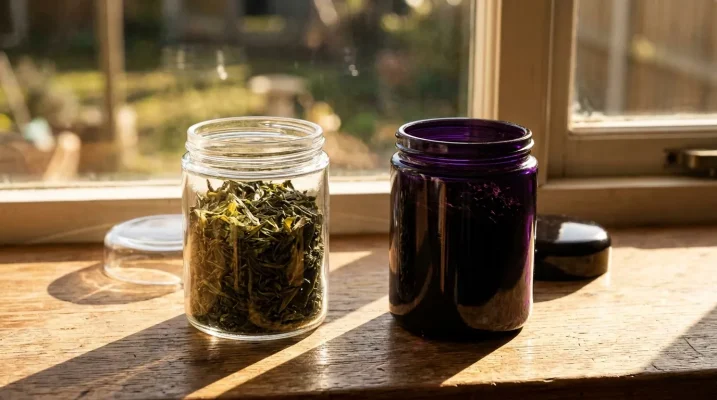
Clear glass on an open benchtop combines two of the five degradation factors at once, light and heat, and it is the error we see most often. The jar usually seals beautifully. It is just parked in the worst possible spot.
The appeal is obvious and worth acknowledging. Rows of glass jars with different leaves visible are genuinely lovely, and being able to see what you have makes you drink it, which is its own kind of freshness strategy.
There are two honest ways out. Keep the clear glass and move it into a closed cupboard, accepting that you lose the visual. Or switch to Miron glass jars, which are violet rather than clear and filter out the wavelengths that do the damage while still reading as glass rather than as a tin. It is the reason we use violet glass for our own tea storage, and it is the one choice that resolves the visibility-versus-freshness tension instead of picking a side.
What should you never store tea in?
Avoid thin plastic containers, timber caddies, paper bags and decorative tins with loose-fitting lids. All four fail at least two of the tests, and the decorative tin is the most deceptive because it looks like exactly the right answer.
Thin plastic absorbs and retains flavour permanently, so the jasmine you stored last year will show up in the chamomile you store next year. Bare timber is porous and holds moisture, which is a real mould risk in a humid kitchen. Paper offers no barrier to anything. And a lid that simply rests on top, however beautifully stamped, is not a seal.
Where should you store tea in your kitchen?
Store tea in a closed cupboard away from the stove, kettle, dishwasher, windows and spice rack. The goal is a spot that stays cool, dark, dry and neutral-smelling, which in most kitchens means a cupboard on an internal wall well away from anything that generates heat or steam.
The specific offenders are all places people genuinely use. The shelf above the stove is the warmest spot in the room. The cupboard beside the kettle takes a blast of steam several times a day. The cupboard above the dishwasher gets humidity every cycle. A west-facing shelf gets afternoon heat and light together, which in an Australian summer is a punishing combination.
In a small kitchen where cupboard space is genuinely limited, get creative rather than compromising:
A closed drawer beats an upper cupboard. Heat rises, so drawers usually run cooler.
Double up your barriers. A tin inside a larger lidded box gives you a second line of defence if the only available shelf is imperfect.
Leave the kitchen entirely. A hallway cupboard, a linen press or a pantry on an internal wall will almost always beat the best shelf in a small hot kitchen.
Keep the spice rack elsewhere. If tea and spices must share a cupboard, put them at opposite ends and make sure both are properly sealed.
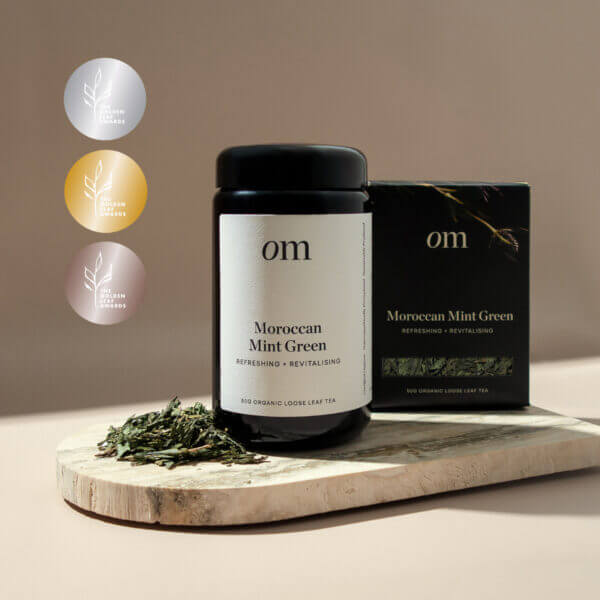
A multi-award-winning Moroccan mint tea with a green base. Refreshing, balanced and certified organic.
Select Options This product has multiple variants. The options may be chosen on the product page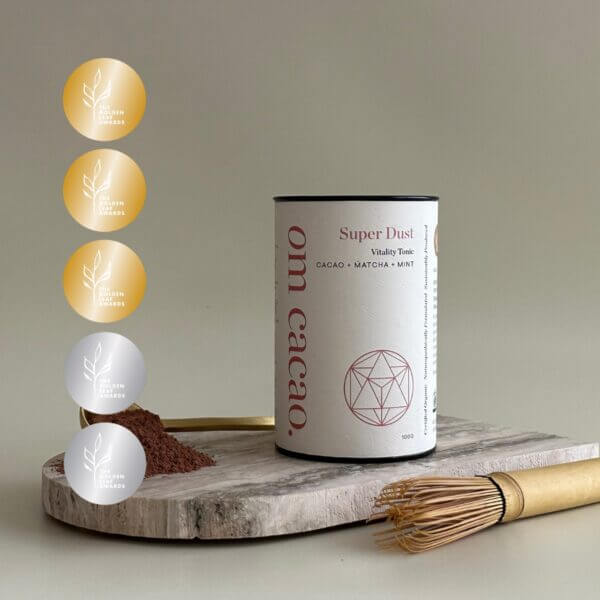
Matcha cacao blended with superherbs for natural energy and enhanced stamina.
Select Options This product has multiple variants. The options may be chosen on the product page
A pure sencha green tea offering light revitalising grassy notes, with smooth slightly sweet overtones.
Select Options This product has multiple variants. The options may be chosen on the product page
A multi-award-winning rooibos tea boasting earthy and nutty flavours with rose overtones, cinnamon & vanilla.
Select Options This product has multiple variants. The options may be chosen on the product pageShould you keep tea in the fridge or freezer?
For almost all tea, no. Refrigeration introduces two problems that outweigh the benefit of a lower temperature: condensation and odour transfer, both of which do more damage than a decent cupboard ever would.
The condensation problem is the decisive one. When you take a cold container out of the fridge and open it, warm humid air meets cold tea and water condenses directly onto the leaf. Do that daily and you are steadily adding moisture to a product that must stay dry.
There is a narrow case where cold storage is defensible, and it has strict conditions. A genuinely high-grade green tea or matcha that you will not get through quickly can be sealed in a small airtight, opaque container, ideally vacuum-sealed or nitrogen-flushed, and refrigerated unopened. The critical rule is that you should bring the sealed container fully to room temperature before opening it, which takes several hours. Open it cold and you have undone the whole exercise.
For everything else, a cool dark cupboard is not a compromise. It is the correct answer.
How long does loose leaf tea stay fresh?
Most loose leaf tea stays at its best for six months to two years depending on type, and remains safe to drink well beyond that. The gap between safe to drink and still worth drinking is where almost all the confusion sits.
Food Standards Australia New Zealand is clear on the safety side. Foods carrying a best-before date rather than a use-by date remain safe after that date has passed, they may simply have lost some quality (4). Tea carries a best-before date. That date is a quality marker, not a safety cliff.
The quality side is less forgiving than most people expect. Analysis of organic green teas stored for one to sixteen years found a significant negative correlation between storage duration and levels of tea polyphenols, total amino acids, soluble sugars, phenolic acids, flavonols, tea pigments and both the umami and sweet amino acids (5). The decline is continuous. There is no cliff edge, tea just quietly keeps getting less interesting.
Tea type | Typical peak window | How it fades |
Green | 6 to 12 months | Loses sweetness and fresh aroma first, turns grassy then hay-like, colour dulls to olive |
White | 6 to 12 months unless deliberately aged | Delicate florals disappear, cup flattens towards plain and papery |
Matcha | 4 to 8 weeks once opened | Vivid jade shifts to olive yellow, umami drops away, bitterness dominates |
Oolong, green style | 12 to 18 months | Floral top notes fade, body thins |
Oolong, roasted | 2 to 3 years | Very stable, roast character softens and integrates |
Black | 2 to 3 years | Slow decline, aroma flattens before taste does |
Pu-erh and aged dark teas | Years to decades | Genuinely improves with correct storage |
Herbal tisanes and flowers | 6 to 12 months | Aromatics go first, colour fades, texture becomes brittle |
Treat these as peak windows rather than deadlines. A two-year-old green tea will not hurt you.
Why does the harvest date matter more than the best-before date?
The harvest date tells you when the clock actually started, and the best-before date does not. A green tea packed eighteen months after harvest can carry a best-before date two years away and already be past its best on the day you buy it.
Most Australian retail packs show only a best-before date, so here is how to work around that:
Look for a flush or year marking. Japanese teas often state the harvest year and sometimes the flush. Darjeeling is usually sold by flush, first flush from March to April and second flush from May to June. Chinese greens are frequently sold by harvest year, and the best are picked before Qingming in early April.
Ask the retailer directly. Any specialist worth buying from knows when their green tea was picked. A vague answer is itself an answer.
Buy green tea in season. New-season Japanese and Chinese greens generally reach Australia from around May through July.
Work backwards where you have to. If a supplier sets best-before dates two years from packing, a date eighteen months out means the tea was packed about six months ago.
None of this matters much for black tea, roasted oolong or pu-erh. However, it is important for green, white and matcha.
How do you store tea in a humid Australian summer?
In a humid climate, moisture control becomes the primary concern rather than one of five. Australian summers and coastal homes push indoor humidity into a range where dried goods pick up water steadily, so the strategy shifts towards smaller quantities, tighter seals and active desiccation.
The scale of the problem varies enormously across the country. Bureau of Meteorology relative humidity averages show markedly higher values in coastal regions and across northern Australia than inland (6). A Brisbane or Darwin kitchen in February is a fundamentally different storage environment from a Canberra kitchen in July, and the same jar will perform differently in each. If you live north of the Tropic of Capricorn or anywhere on the coast, treat the advice below as essential rather than optional.
Buy smaller. A 50g pack you finish in six weeks never gets the chance to absorb a wet season. Two 500g jars sitting open through February will.
Decant as you go. Move tea into progressively smaller jars as you use it, so headspace stays low and there is less humid air trapped with the leaf.
Use food-safe desiccant. A small silica gel sachet in the cupboard, not loose in the tea, buffers the surrounding air. Dry it out or replace it periodically, because a saturated sachet does nothing at all.
Open jars away from steam. Never decant while the kettle is boiling beside you, and never over a sink of hot water.
Choose the coolest room. In a home without air conditioning, an internal hallway cupboard will usually be cooler and more stable than any kitchen shelf.
Watch the appliance cupboards. Australian kitchens often stack the dishwasher, kettle and toaster along one run of bench. Whatever cupboard sits above that run is the worst in the house for tea storage.
How do you tell when tea is past its best and what to do with it?
Tea that is past its best has lost its aroma, dulled in colour and stopped feeling brittle. Pick it up, smell it and look at it, in that order. Your nose will tell you before your eyes do.
Aroma. Open the jar and inhale before your palate has anything to compare it to. Fresh tea has a defined, specific smell. Faded tea smells generically of dry leaves, or of very little. A stale, hay-like or faintly fatty note is the specific signature of oxidative decline.
Colour. Green tea shifts from bright to olive to brownish. White tea greys. Herbal flowers go from vivid to washed out. Black tea changes least, which is part of why it hides its age so well.
Texture. Well-stored leaf snaps cleanly between your fingers. Leaf that has absorbed moisture bends instead of breaking and feels slightly soft.
Clumping. Loose leaf should move freely in the jar. Clumps mean moisture has got in, and moisture means the clock has started. Worth checking by hand once a month through summer.
Those are all quality signals, and quality decline just means a less interesting cup. There are also clear-cut signs that mean the tea should be thrown out rather than tolerated: any visible fuzz or mould on the leaf, any musty or cellar-like smell, and any leaf that feels damp. In those cases discard the whole jar rather than picking out the affected portion, then wash and thoroughly dry the container before reusing it.
What can you do with tea that has faded?
Faded tea is not rubbish, it is just no longer at its best as a hot brew. Almost every use below works better with older tea than drinking it straight does, because they either extract more gently or add flavour alongside it.
Cold brew it. A long, cold extraction of eight to twelve hours in the fridge pulls out sweetness and body while leaving most of the bitterness behind. It is remarkably forgiving of tired leaf, and it is the first thing to try.
Make iced tea. Brew it strong, chill it and add citrus, fresh mint or stone fruit. The additions cover what the leaf has lost.
Cook with it. Use brewed tea instead of water for rice, quinoa or a poaching liquid for pears and peaches. Smoky black teas make an excellent base for braises.
Bake with it. Grind the dry leaf finely and fold it into shortbread, cake batter or a spice mix. Chai, Earl Grey and matcha all work particularly well this way.
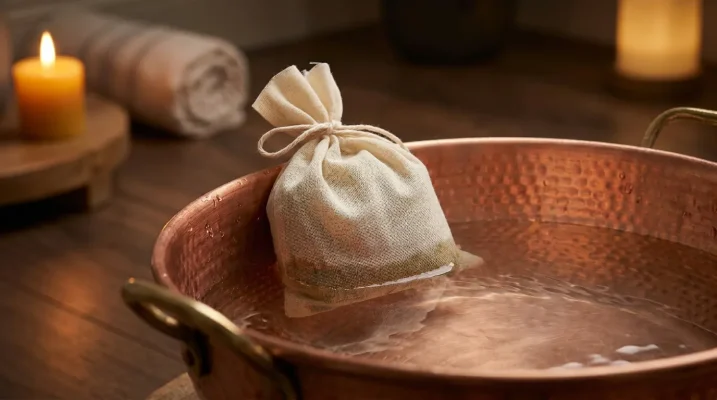
Put it in the bath. Tie the leaf into a muslin bag and drop it into a warm bath, the same way you would use botanicals in a mineral bath soak. Chamomile, rose and green tea are all lovely for this.
Deodorise with it. Dry leaves in an open jar will absorb odours in a fridge or a pair of shoes, which is the very property that ruined the tea in the first place, finally put to work.
Compost it. Loose leaf tea composts readily and adds nitrogen. Just make sure there is no staple or synthetic bag material in with it.
The only tea that should go in the bin rather than into one of these is tea with visible mould or a musty smell.
What are the most common tea storage mistakes?
These are the errors that undo everything else you do well:
The clear jar on the sunny bench. Beautiful, and the fastest way to fade a good green tea.
The wet spoon. One rinsed and undried teaspoon can seed mould in an otherwise perfect jar.
The jar three times too big. Thirty grams of tea in a 500 ml canister is mostly headspace, and headspace is oxygen.
Storing above the stove. The warmest cupboard in the house, chosen purely for convenience.
Keeping tea in the fridge. Condensation on every opening, plus whatever else was in there with it.
Buying more than you can drink in a season. The bulk discount is not a discount if half of it is stale before you reach it.
Never washing the jar between teas. Especially after a chai or a scented blend.
Leaving the scoop inside the container. It picks up humidity from the room every time the lid comes off.
Trusting a decorative tin. A lid that rests rather than seals is display, not storage.
Once your tea is stored properly, the other half of the equation is getting the brew right. Our guide to how to brew tea covers water temperature, ratios and steeping times by type.
Frequently asked questions about how to store loose leaf tea
In an airtight, opaque container made from an inert material, sized close to the amount of tea it holds, kept in a cool dark cupboard away from the stove, kettle, dishwasher and spice rack. Use a dry spoon every time and never store the scoop inside the jar.
Not in the way perishable food does. Properly dried tea kept dry does not become unsafe, it loses aroma, flavour and beneficial compounds progressively. The exception is tea that has taken on moisture, which can develop mould and should be discarded.
Generally yes, provided it has been stored properly and shows no signs of moisture damage. A best-before date is a quality marker rather than a safety limit. If the tea smells musty or looks fuzzy, throw it out regardless of the date.
Yes, and dry it completely before refilling. This matters most after strongly scented blends such as chai, jasmine or anything with citrus oils, which leave traces that will show up in the next tea you store.
Yes, if the tea does not fill it. The empty space holds oxygen, and that oxygen is replaced every time you open the lid. Match the container to the quantity and decant into something smaller as the tea runs low.
It is the weakest option. Thin plastic absorbs and holds flavours permanently, offers poor light protection and rarely seals as well as glass, tin or steel. If it is all you have, keep it in a dark cupboard and treat it as temporary.
Because dry tea leaf readily absorbs aromas from the air around it. Either the container is not genuinely airtight, or it is stored beside something strongly scented such as spices, coffee or cleaning products. Fix the seal first, then the location.
It does no harm and can help, particularly if the pouch is foil-lined and the jar is clear glass. You get a double barrier against light and air. Press the air out of the pouch before closing it, and make sure the jar itself still seals.
Yes, and arguably more care. Tea in bags is usually more finely broken, which means more surface area exposed to air. Unwrapped bags sitting in an open box in a warm kitchen fade quickly. Keep them sealed, cool and dark like anything else.
Use a small airtight tin holding two or three brews, or sealed single-serve pouches. Both resist crushing, keep light out and seal well enough for a couple of weeks. Avoid paper bags and zip-lock bags, which let leaf crush into dust and let humidity in. Leaf that has been knocked about in transit brews faster and stronger, so shorten your steeping time a little.
How to make loose leaf tea
How do you make loose leaf tea at home? Ratios, temperatures and steeping times by [...]

Lemon Myrtle Tea Cake
This lemon myrtle tea cake is proof that there’s something undeniably lovely and nostalgic about [...]

How to Make Iced Tea
Are you wondering how to make easy iced tea at home with loose tea? For [...]
References
Wang, J., Xu, Y., Xu, C., You, H., Xie, T., Guo, H., Chen, P., Chu, Q., Gong, S. and Fan, F. (2025) ‘Impact of utilization of oxygen scavenger on aroma quality of Longjing tea during storage at elevated temperature’, Food Chemistry: X, 25, 102069.
Li, N., Taylor, L.S. and Mauer, L.J. (2011) ‘Degradation kinetics of catechins in green tea powder: effects of temperature and relative humidity’, Journal of Agricultural and Food Chemistry, 59(11), pp. 6082-6090.
Janik, E., Niemcewicz, M., Ceremuga, M., Stela, M., Saluk-Bijak, J., Siadkowski, A. and Bijak, M. (2020) ‘Molecular aspects of mycotoxins: a serious problem for human health’, International Journal of Molecular Sciences, 21(21), 8187.
Food Standards Australia New Zealand (n.d.) Use-by and best-before dates.
Wen, X., Han, S., Wang, J., Zhang, Y., Tan, L., Chen, C., Han, B. and Wang, M. (2024) ‘The flavor characteristics, antioxidant capability, and storage year discrimination based on backpropagation neural network of organic green tea (Camellia sinensis) during long-term storage’, Foods, 13(5), 753.
Bureau of Meteorology (n.d.) Average 9 am and 3 pm relative humidity.