

How to make loose leaf tea
Key Takeaways:
Use 1 heaped teaspoon of leaf per 250 ml cup, or 2 if the leaf is light and flowery.
Match the water to the tea: near boiling for black, chai, rooibos and herbal infusions, cooler for green, white and oolong.
Steep by the clock, then get the leaves out of the water.
If your cup tastes bitter or leaves your mouth dry, the water was too hot, the steep ran too long or the leaves are still sitting in the cup.
Adjust strength with more leaf, never with more time.
Table of contents (click to jump)
- How do you make loose leaf tea, step by step?
- Why does my loose leaf tea taste bitter or dry?
- How do you brew loose leaf tea without an infuser or teapot?
- How to make loose leaf tea gongfu style?
- How do you drink loose leaf tea, with milk or without?
- Frequently asked questions
Loose leaf tea is not harder to make than a tea bag. It just asks you to make three decisions the bag makes for you: how much leaf, how hot the water, how long it sits. Get those right and the difference is immediate. The same jasmine green that tasted thin and grassy comes out soft and floral, and you wonder what you were doing wrong for years.
How do you make loose leaf tea, step by step?
To make loose leaf tea, put one heaped teaspoon of leaf per 250 ml of water into a pot or infuser, pour over water heated to the right temperature for that tea, steep for the recommended time, then take the leaves out and drink. The leaf needs room to unfurl and the water needs to come off the leaf when the time is up. Everything else is refinement.
Warm the pot or cup. Swirl a little hot water around it and tip it out. A cold vessel pulls several degrees out of your brewing water the moment you pour, which matters most for black tea.
Measure the leaf. One heaped teaspoon per cup is the working rule. Weigh it if you can.
Heat the water. Fresh cold water, brought to the temperature that suits your tea rather than always to a rolling boil.
Pour and let it move. Fill the pot or infuser so the leaves are fully submerged and free to swell. Watch a rolled oolong open in the first thirty seconds and you will never go back to a cramped little basket.
Time it. Use a timer, not a guess. 2 minutes and 4 minutes are different drinks.
Take the leaves out. Lift the infuser or pour the whole pot off the leaf. Tea left standing on its leaves keeps extracting and goes harsh in the time it takes you to drink it.
A glass teapot makes step four visible, which is the fastest way to learn what a good steep actually looks like. A stove top kettle gives you more control over step three than a plastic jug will.

1.2L Glass Teapot with Infuser. Made of highly durable borosilicate glass. Can be combined with Tea Warmer.
Select Options This product has multiple variants. The options may be chosen on the product page
400ml T42 Glass Teapot from Germany with glass infuser. Brews 2 cups. Also available with Warmer Setup.
Select Options This product has multiple variants. The options may be chosen on the product page
This single cup loose leaf tea infuser provides a convenient method for brewing loose leaf herbal tea.

How much loose leaf tea do you use per cup?
One heaped teaspoon per 250 ml cup, which is roughly 2.5 to 3 g. Use two heaped teaspoons for anything light and bulky, such as chamomile flowers, rose petals or a fruit blend.
Spoons mislead because leaf density varies enormously. A heaped teaspoon of tightly rolled gunpowder green weighs about three times what the same spoon of dried chamomile tea weighs, so the same measure gives you a strong cup of one and a weak cup of the other. If you drink tea daily, small kitchen scales or a brass measuring spoon will make your cups repeatable in a way that eyeballing never will.
For a pot, scale by volume rather than by cups: 5 to 6 g for a 500 ml pot, 10 to 12 g for a litre. And when tea comes out weak, add leaf rather than time. Longer steeping does not make a thin brew fuller, it makes it drier and sharper.

What temperature should the water be?
The rule is simple: the more delicate the leaf, the cooler the water. Anything robust and fully oxidised takes water straight off the boil, while green, white and oolong want it well below, down to around 75 °C for a fine green tea. The brewing chart below gives you every figure.
Temperature changes what actually comes out of the leaf, not just how fast. A 2019 laboratory analysis of green tea infusions brewed at 60°C and 95°C found the chemical profile shifted with both temperature and time, with total catechins peaking at 95°C after about ten minutes then falling away as the compounds changed form (1). That is bench chemistry rather than a taste panel, but it explains something you can taste directly. Brew a good sencha at 75°C and it comes out sweet and almost brothy. Brew the same leaf with boiling water and you get spinach water.
Without a variable temperature kettle, the reliable trick is dilution: pour 200 ml of boiled water and top it with 50 ml of cold, which lands you somewhere near 85°C. Letting an open kettle stand for a few minutes also works, but how far it drops depends on the kettle, the volume and the room, so treat it as a rough guide and taste as you go.
How long should you steep loose leaf tea?
2 to 5 minutes for anything from the tea plant, at the short end for green and oolong and the long end for white. Five to ten minutes for herbal infusions, which have more to give and will not turn bitter on you.
Herbal infusions genuinely need a heavier hand, and the traditional dosing reflects that. The European Medicines Agency herbal monograph for chamomile flower specifies 1.5 to 4 g in 150 ml of boiling water, taken three to four times daily, which is well above what you would use for black tea (2). We usually steep herbal blends for 5 to 10 minutes as a matter of course, and some blends like e.g. Turkish Delight Tea for up to 15 minutes, so the aroma gets rounder and sweeter. Flowers, leaves and roots simply release what they hold at their own pace, which is what sets herbal infusions apart from true tea once the water goes in.
Loose leaf brewing chart
Starting points, not commandments. The last column is what the leaf will usually give you rather than a promise.
Tea | Leaf per 250 ml | Water | Steep | Further infusions |
1 heaped tsp | 95 to 100 °C | 3 to 4 min | 1 to 2 | |
1 heaped tsp | 75 to 80 °C | 2 to 3 min | 2 to 3 | |
White | 2 tsp, it is bulky | 80 to 85 °C | 3 to 5 min | 2 to 3 |
Oolong | 1 heaped tsp | 90 to 95 °C | 2 to 3 min | 3 to 5 |
1 heaped tsp | 95 to 100 °C | 4 to 5 min | 1 to 2 | |
1 heaped tsp | 100 °C | 5 to 7 min | 1 | |
2 tsp | 100 °C | 5 to 8 min | 1 | |
Herbal infusion | 2 tsp | 100 °C | 5 to 10 min | 1 |
The bottom four rows behave differently from the top four because they are not the same plant, and the six different types of tea that come from Camellia sinensis each want their own handling for reasons that go back to how the leaf was processed.

A pure sencha green tea offering light revitalising grassy notes, with smooth slightly sweet overtones.
Select Options This product has multiple variants. The options may be chosen on the product page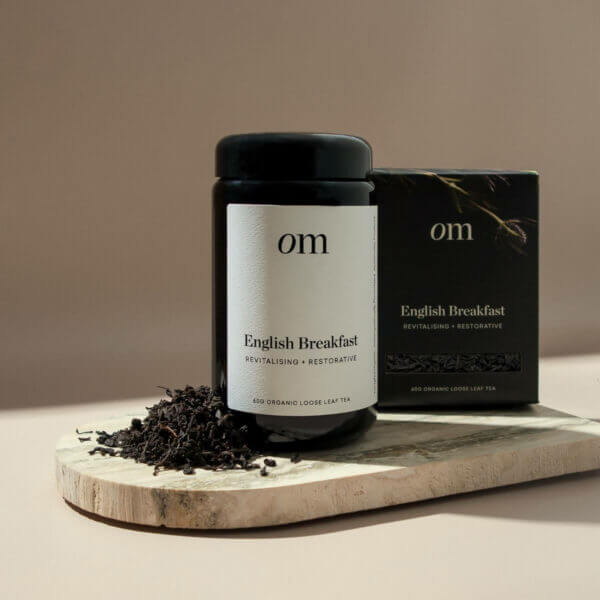
OM's English Breakfast Tea is a full-bodied, loose leaf, premium grade Orange Pekoe Black Tea.
Select Options This product has multiple variants. The options may be chosen on the product page
A multi-award-winning rooibos tea boasting earthy and nutty flavours with rose overtones, cinnamon & vanilla.
Select Options This product has multiple variants. The options may be chosen on the product page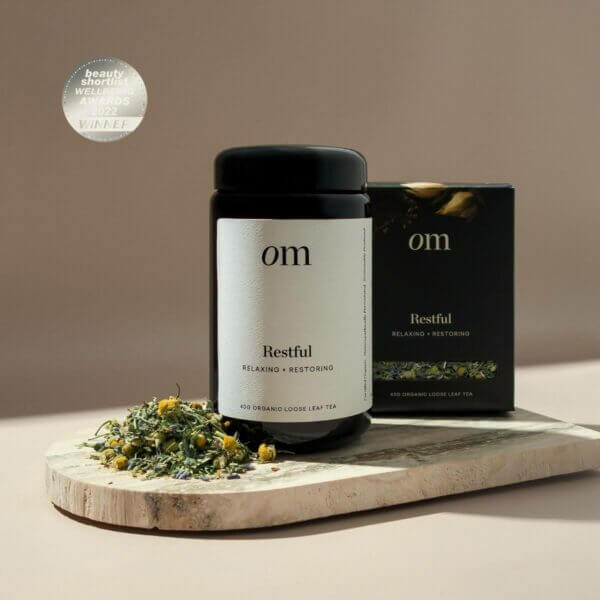
A restoring tisane imbued with calming chamomile, lemon and comforting lavender, for relaxing sleep.
Select Options This product has multiple variants. The options may be chosen on the product pageWhy does my loose leaf tea taste bitter or dry?
Bitterness and that dry, puckering feeling across the tongue almost always come from over-extraction: water too hot, steep too long, or the leaves still sitting in the cup while you drink.
That dry sensation is astringency, and it is happening in your mouth rather than in the pot. Tea polyphenols bind to proteins in your saliva and clump together, which strips away the way saliva lubricates your tongue. A 2022 in vitro study using an artificial salivary protein assay ranked the tea catechins by astringency, found the gallate-type ones were harshest, and showed that extending brewing time raised astringency exponentially rather than in a straight line (3). Laboratory work rather than a taste panel, but it matches the cup: a minute over does far more damage than you would expect.
The usual culprits, in the order worth checking:
Water too hot. Drop it by 10 °C before you change anything else. This is the single most common mistake with green tea.
Steeped too long. Take 30 seconds off, not 2 minutes.
Leaves left in the cup. Decant, or lift the basket out. This is the mistake most people do not know they are making.
Too much broken leaf. Fine particles and dust extract much faster than whole leaf. If the bottom of the pouch is mostly fragments, use slightly less and shorten the steep.
Stale leaf. Old tea does not usually turn bitter, it goes flat and dull and smells of nothing when you open the jar. That is a storage problem, and storing loose leaf tea properly will do more for you than any change to your method.
Water is the quiet variable behind all of this. A 2021 analysis found that as water hardness increased, total catechin yield from green tea dropped and the infusion browned, with the alkaline bicarbonate levels in some hard tap water making it poorly suited to green tea altogether (4). If your tea looks dull and tastes flat despite everything else being right, try it once with filtered water before you blame the leaf.
How do you brew loose leaf tea without an infuser or teapot?
You do not need any special equipment. Put the leaves straight into a mug, pour the water, wait, then either strain the tea into a second mug or drink around the leaves. Loose leaf tea was made this way for centuries before infusers existed.
Steep and strain. Leaves in the mug, water over, timer on. When the time is up, pour the tea through a small kitchen sieve into a second cup. A tea strainer does it more neatly, but any fine mesh works.
Leaves in the glass, or grandpa style. Leaves in a tall glass, hot water over, and you drink from the top as the leaves sink. Top up with more hot water through the day. This only works with herbal and fruit infusions and us terrible with anything that turns bitter fast, since the leaves never come out.
One piece of equipment to skip: the little clip-shut tea ball. It squeezes the leaf into a space where it cannot open, and you get a thin cup from good tea. If you are buying anything, buy a infuser basket wide enough for the leaves to move.
How do you brew loose leaf tea gongfu style?
Gongfu brewing uses far more leaf in far less water and pulls a series of very short infusions from it. Roughly 5 g of leaf to 100 ml of water, steeps measured in seconds rather than minutes, and the same leaf carrying six or more rounds. It is a traditional Chinese method, and the point is to taste how a tea changes as it opens.
Warm a small pot or gaiwan, add enough leaf to cover the base generously, then rinse.
Fill with hot water and pour it straight out again, which wakes the leaf and warms your cups at the same time.
Fill again and pour off after about 20 seconds for the first real infusion. Add 5 to 10 seconds to each round after that, tasting as you go, and stop when the cup goes thin.
A good oolong will move from bright and floral in the first cups to thick and stonefruit-sweet by the fourth.
Two rules make or break it. Pour the pot out completely every time, because anything left behind keeps extracting. And use a leaf worth the attention, usually an oolong or a single origin tea with enough going on to change from cup to cup.
How do you drink loose leaf tea, with milk or without?
Milk suits robust black tea and chai and nothing else. Green, white and oolong are ruined by it, and so are floral and fruit blends. Everything else is preference, so drink it the way you actually enjoy it.
Milk works with a strong black tea for a reason that is chemical as well as habitual. Casein in milk binds tea polyphenols, which reduces their interaction with the proteins in your saliva and softens astringency, a mechanism set out in a 2002 review of polyphenol and salivary protein interactions (5). That is why an Australian Wattleseed Tea takes milk happily and a delicate green does not: there is nothing there that needs softening, and the milk simply flattens the aroma.
Lemon does something different again. It drops the pH and lightens the colour of black tea noticeably, and it lifts anything citrus or herbal. It fights with the bergamot, lavender and rose in a French Earl Grey, which is already carrying plenty of aromatics.
On sweetening, taste the tea first. Rooibos and liquorice blends, like our Energy Tea, are naturally sweet and usually need nothing at all. If you do sweeten, a little honey stirred into the hot tea dissolves properly, whereas honey added to a cooled cup sits in a lump at the bottom.
Frequently asked questions
Yes, noticeably. Very hard water dulls flavour, darkens the colour and leaves a shiny film on the surface of black tea, and heavily chlorinated tap water carries its own smell straight into the cup. Filtered water is enough for most people, with no need for distilled or heavily mineralised bottled water. Use freshly drawn water rather than reboiling what is already sitting in the kettle.
Yes, and it is the least bitter way to drink it. Use roughly the same leaf you would for hot tea, cover with cold water, and leave it in the fridge for 4 to 12 hours depending on the blend. Because the water never gets hot, far less of the astringent compounds come out, so the result is smoother and rounder. Ratios, timings and what to do with the result are in our guide to making iced tea at home, and there are iced tea cocktail recipes if you want to take it further.
Yes, and it is one of the better improvised methods because the leaves have room to move. Add the leaf, pour water at the right temperature, steep, then press and pour the whole lot into cups. Do not leave tea sitting on the plunged leaves, since the plunger holds them against the liquid rather than removing them. Keep one for tea if you can, because coffee oils cling to the mesh.
Often, yes. Green and oolong typically give two to five good infusions, white tea two or three, black tea one or two, and most herbal and fruit blends only one. For ordinary mug or pot brewing, add thirty seconds to a minute to each round. Gongfu brewing is a different regime, with much shorter steeps that build by only five to ten seconds. Either way, re-steep the same day and keep the leaves damp rather than drying them out and returning tomorrow.
Mostly leaf size. Bags are usually filled with small broken pieces and dust, which extract fast and unevenly and give a cup that hits hard at first and tastes hollow underneath. Whole leaf extracts more slowly and holds on to the aromatic compounds that make a tea taste of somewhere specific. You can also see exactly what you are drinking, which is not a small thing with herbal and fruit blends.

How to store loose leaf tea: The complete guide to keeping it fresh
Learn how to store loose leaf tea the right way: What containers are best, where [...]
Aug

How to Make Iced Tea
Are you wondering how to make easy iced tea at home with loose tea? For [...]
Jul

True Tea Vs Herbal Tea – What is the difference
True tea comes from one plant, herbal tea from any other. We explain what that [...]
Sep
References
Comprehensive Investigation of the Effects of Brewing Conditions in Sample Preparation of Green Tea Infusions. Molecules, 2019. https://www.mdpi.com/1420-3049/24/9/1735
European Medicines Agency, Committee on Herbal Medicinal Products. European Union herbal monograph on Matricaria recutita L., flos, 2015. https://www.ema.europa.eu/en/documents/herbal-monograph/final-european-union-herbal-monograph-matricaria-recutita-l-flos-first-version_en.pdf
Liu CT, Tzen JTC. Exploring the Relative Astringency of Tea Catechins and Distinct Astringent Sensation of Catechins and Flavonol Glycosides via an In Vitro Assay Composed of Artificial Oil Bodies. Molecules, 2022. https://www.ncbi.nlm.nih.gov/pmc/articles/PMC9457659/
Effect of Water Hardness on Catechin and Caffeine Content in Green Tea Infusions. Molecules, 2021. https://www.ncbi.nlm.nih.gov/pmc/articles/PMC8229914/
Bennick A. Interaction of Plant Polyphenols with Salivary Proteins. Critical Reviews in Oral Biology and Medicine, 2002. https://journals.sagepub.com/doi/full/10.1177/154411130201300208